Scams: Why Prevention Matters More Than Recovery — And What You Can Do
We’ve all seen the headlines. A retiree loses RM100,000 to a fake investment. A student gets trapped in a job scam. A single mother sends her savings to a “courier fee” for a romance scam.
And almost every time, we hear the same heartbreaking truth:
Once the money is gone, it’s nearly impossible to get it back.
That’s why it’s time we shift the focus:
From recovering after the scam, to avoiding it in the first place.
💸 What Happens to Your Money After a Scam?
Once you transfer your money to a scammer, it moves fast—sometimes disappearing within minutes.
-
The funds usually go into a mule account—a bank account often obtained illegally through deception. These accounts are controlled by syndicates or sold by desperate individuals unaware they’re enabling a crime.
-
Scammers may use online transfers, e-wallets, or debit cards to withdraw or reroute the money across multiple accounts.
-
If the amount is large, daily transfer limits might stop all the money from vanishing immediately—but even then, only partial recovery is likely.
In Malaysia, we have a National Scam Response Centre (NSRC – Call 997) to freeze suspicious transactions—but the window to act is very narrow.
👮♀️ Why You Should Still Make a Police Report
Even if your money is likely gone, reporting the scam is essential. Here’s why:
-
Build National Awareness
Your report contributes to national statistics and helps the authorities understand the latest scam tactics and trends. -
Prevent Others from Falling Victim
Your experience might become the warning that saves someone else—especially if the scam uses the same script or approach. -
Support International Investigations
Scammer networks are global. The information you provide could be the missing link to crack down on a syndicate.
Bak kata pepatah: “Sepandai-pandai tupai melompat, akhirnya jatuh ke tanah juga.”
No matter how clever the scammer, they will fall—especially when communities stand together.
🧠 Use AWARE to Outsmart Scammers
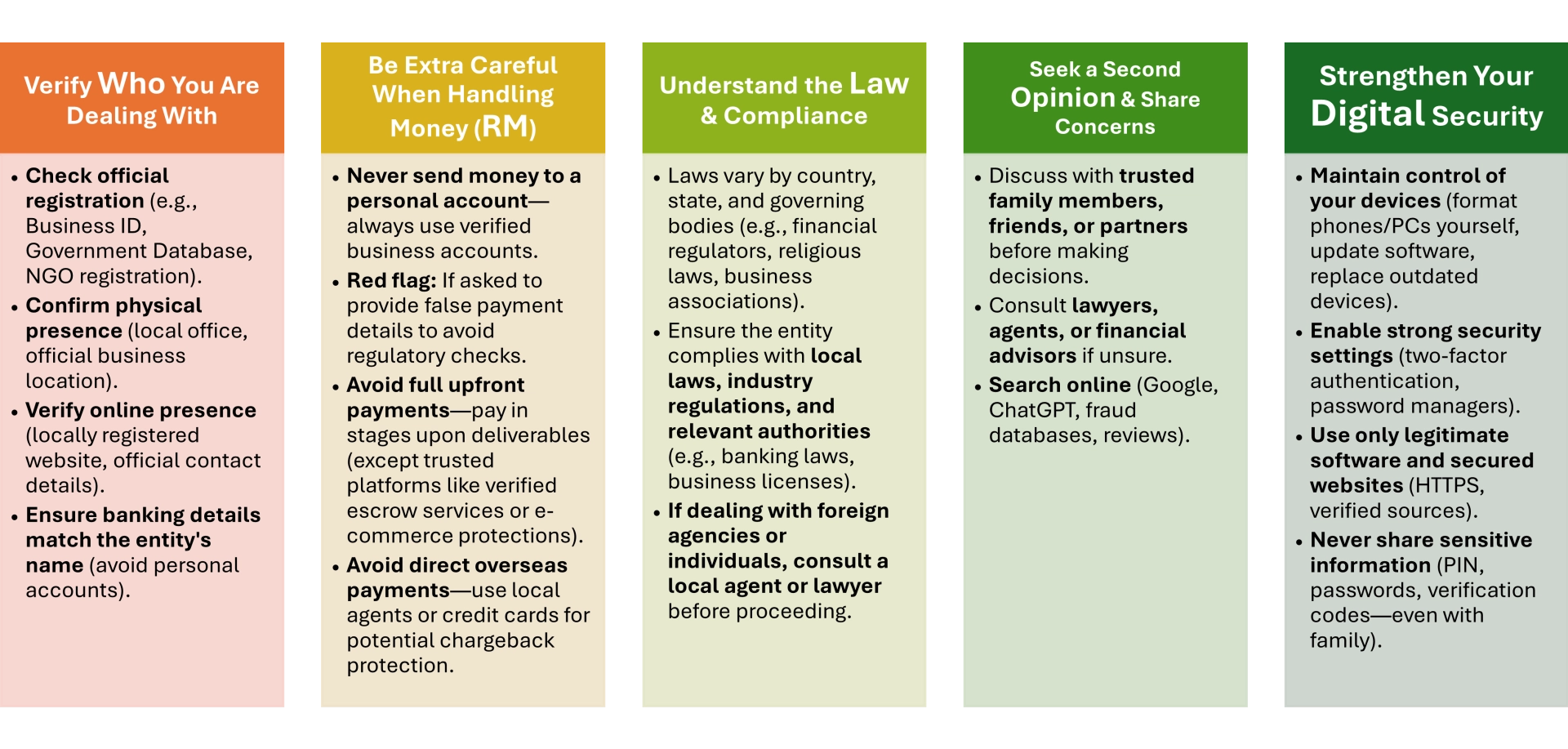
To avoid being a victim, you don’t need to live in fear—you need to live with awareness. That’s where AWARE comes in: a practical mindset to apply every time someone offers you an “opportunity”, asks for money, or pressures you to act fast.
🛡️ AWARE stands for:
-
A – Ask & verify who you’re dealing with
Don’t trust blindly. Call the company, check the source, verify identities through official channels. -
W – Watch your financial transactions
Regularly monitor your bank accounts. Set alerts. Be suspicious of unknown payments or small “test” transfers. -
A – Analyze legal implications
Is the offer too good to be true? Could this be illegal or lead you into trouble? Don’t ignore red flags. -
R – Reach out for second opinions
Talk to family, friends, or trusted professionals before making financial decisions or responding to urgent requests. -
E – Enhance your digital security
Use strong passwords, enable two-factor authentication, and update your devices. Scammers exploit weak points.
🌍 You’re Not Just Protecting Yourself—You’re Protecting Your Community
Scams don’t just affect individuals—they hurt families, communities, and trust in society.
By being informed, asking questions, and sharing your knowledge, you’re taking part in a collective defense.
✅ Help your parents spot fake bank calls.
✅ Teach your kids to question unknown DMs.
✅ Remind friends to pause before investing in “guaranteed” profits.
Because when we all stay AWARE, we stand together.
Final Thought:
Avoiding a scam is always better than trying to recover from one.
So don’t just react—prepare, stay informed, and take your part in the fight.
Together, we can outsmart the scammers.

