Postgraduate Study vs. Industry Experience: How to Balance Both Paths
| Navigating Postgraduate Pathways – (3)
In a rapidly evolving technological era, professionals and fresh graduates alike often find themselves at a crossroads: should they pursue further studies or dive into the industry?
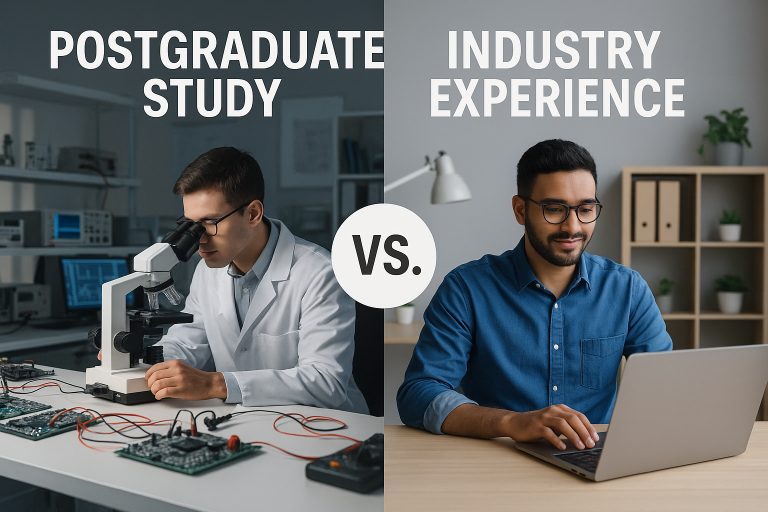
Previously, I discussed the increasing relevance of advanced degrees in our AI-driven world, especially in relation to innovation and career adaptability (read that post here). This reflection naturally leads us to an equally crucial consideration—how can one balance postgraduate study with real-world industry experience?
The Perceived Trade-Off: Academia vs. Industry
For many, the decision feels binary. Industry is fast-paced, lucrative, and offers hands-on exposure. Academia, on the other hand, is often seen as theoretical, niche, and time-intensive. But in truth, this dichotomy is outdated.

As someone who supervises postgraduate students with interests in AI, multimedia systems, embedded software, and interdisciplinary technology, I’ve observed firsthand how blending both pathways can yield richer insights and more impactful outcomes.
Why Choose Postgraduate Study?
Let’s begin by acknowledging that postgraduate study is not merely about adding a qualification to your CV. Done right, it deepens your capacity for critical thinking, sharpens your ability to frame and solve complex problems, and exposes you to the frontier of technological advancement.
For instance, a student exploring deep learning for medical imaging not only builds niche technical expertise but also contributes to societal good—an experience that rarely occurs in a standard industry setting.
Moreover, research settings allow you to:
-
Work with cutting-edge tools in a structured environment
-
Develop intellectual independence
-
Engage in global academic networks and conferences
-
Influence the direction of future technologies
The Value of Industry Experience
That said, the industry provides a crucial perspective. It teaches pragmatism, teamwork under pressure, and fast prototyping cycles—traits that enhance your research acumen.
I’ve seen students return from industry internships with new clarity on their thesis direction, or those who joined postgraduate study after years in the field, bringing invaluable domain knowledge. One of my recent supervisees, who had a few years of embedded systems development under his belt, designed a real-time diagnostic module that was both academically sound and commercially viable.

In short, experience in the field doesn’t detract from academic pursuit—it enriches it.
The Best of Both Worlds: Strategies for Balance
So, how can you, as a prospective student or mid-career professional, integrate both worlds?
1. Consider Part-Time or Modular Postgraduate Programs
Many universities—including UTeM—offer part-time options that allow working professionals to pursue advanced research without putting their careers on hold.
2. Engage in Industry-Linked Research
Look for research projects with real-world applications or those conducted in collaboration with industry partners. These opportunities are especially common in areas like AI-driven automation, sensor integration, or industrial multimedia analytics.
3. Leverage Professional Experience as Research Input
If you’re already in the field, your day-to-day challenges might be hiding rich research questions. Supervisors like myself often encourage candidates to develop proposals rooted in lived experience—ensuring that the research stays relevant and grounded.
4. Join Applied Research Clusters or Innovation Labs
These platforms often exist within universities and serve as bridges between academia and industry. They are ideal for students who want to stay connected with industrial trends while pursuing their research.
A Word to Potential Candidates
You don’t need to have all the answers when starting your postgraduate journey. What matters is your curiosity, your commitment to growth, and your openness to guidance. Whether your background is purely academic, purely industrial, or a hybrid of both, the path forward can be tailored to suit your goals.

As someone actively supervising in fields such as AI, embedded system design, and tech-based societal research, I welcome conversations with curious minds—whether you’re exploring postgraduate options or considering how to re-enter academia after years in industry.
Let your career be shaped not by conventional routes, but by informed, intentional choices.